
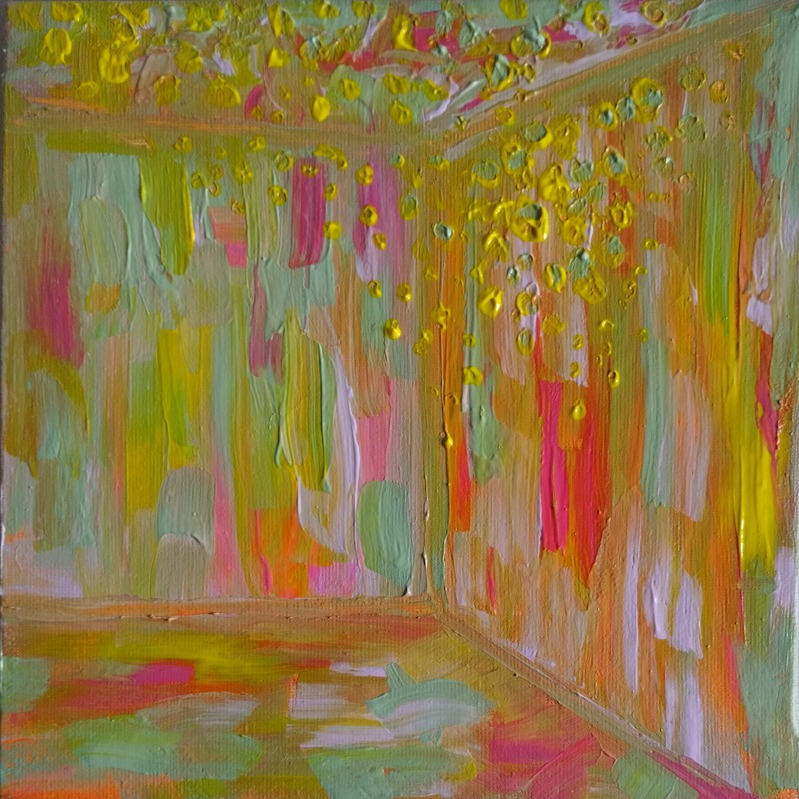
Layer by layer, the story unfolds.…
In painting, layers create depth, texture and sometimes something completely unexpected.
What I love about building a painting in layers is that, at some point, it begins to feel alive. It develops a history. One layer changes what came before it, while traces of what lies underneath remain visible – quietly carrying the story forward.
Perhaps life is much the same.
The Layers We Carry
We move through life collecting layers: family, friendships, relationships, work, parenthood, loss, love, belonging and change. Some people become part of our lives for decades; others touch us briefly and still leave a mark.
Each experience adds something to who we become.
Our circumstances add their own layers too. Whether we have a strong support system or are self made. Whether we are healthy or struggling. Whether we choose to live in our hometown or migrate to a foreign land and build a new life from scratch.
The same person can behave, feel and express themselves very differently depending on what is happening around them.
But beneath these visible layers are deeper ones.
The Unspoken Rules of Childhood
There is the layer of childhood – the way we were raised, the environment we grew up in, the spoken and unspoken rules we absorbed. That early canvas is never completely painted over. It continues to influence how we see ourselves, how we relate to others and, perhaps most clearly, how we raise our own children.
Then there is our relationship with our younger self.
How do we speak to ourselves when we are overwhelmed?
How much compassion do we have for our own vulnerability?
Are we gentle with ourselves – or relentlessly demanding?
Often, the way we treat ourselves today carries an echo of what we experienced long ago.
And these inner layers inevitably find their way into our relationships: how we love, how we trust, how we protect ourselves, how we set boundaries, and how we seek connection and safety with the people around us.
Even parenthood is experienced differently. We may share the same role, but our inner state and circumstances shape how we inhabit it.
So, yes, we may have many versions of ourselves.
But that doesn’t make us unreal or inconsistent.
These versions are simply different expressions of the same Self – shaped by different roles, needs, circumstances and expectations, and by the people we care for.
We often see only the visible layer of a person. We rarely see everything underneath it.
And this is where painting comes in.
Intuitive Painting for Self-Discovery: When We Stop Controlling
Life keeps us busy thinking, deciding, organising, responding and fulfilling one role after another.
There isn’t always much space left to simply listen inward.
Painting can create that space.
When we paint intuitively, we don’t necessarily begin with a plan of what the finished painting should look like. We enter a quiet state of flow—following what appears in the moment through colour, movement, shape, texture, and instinct.
And somewhere along the way, something can shift.
Listening Inward Through Intuition
The painting becomes more than an image. It becomes a kind of inner conversation.
An emotion that was difficult to put into words may find its way onto the canvas through colour. A thought we have been carrying may suddenly be seen differently. Something we didn’t consciously intend may emerge – and surprise us.
Sometimes we discover what we need only after we stop trying to figur it out.
I believe intuition has its own intelligence. Perhaps it knows what we are ready to see before our conscious mind does. But it doesn’t necessarily reveal everything at once. It reveals what we are able to receive.
As we become absorbed in the process, we become quieter.
And in that quiet, we may finally hear what the noise of everyday life has been drowning out.
Staying Curious in the Quiet
Of course, silence can feel uncomfortable.
When we stop distracting ourselves, we don’t always know what might surface. There can be uncertainty, vulnerability – even fear.
But perhaps the magic begins when we don’t run from that discomfort.
We simply stay curious.
We don’t have to analyse the painting. We don’t have to search for the “right” meaning or turn every brushstroke into a revelation.
We can simply notice.
Meeting Ourselves with Self-Compassion
Because knowing something intellectually and truly hearing it within ourselves are not always the same thing.
And perhaps what we discover beneath all those layers is the most beautiful part of all:
Our inner Self is not working against us.
There is Love there.
A quiet part of us that knows what we need. A part that can meet us with compassion when we finally become still enough to listen.
Maybe the purpose isn’t to peel away every layer until we reach some supposedly perfect version of ourselves.
Maybe it is to accept the layers.
To recognise how every experience, relationship, wound, joy and transformation has contributed to who we are – and to become conscious of who we choose to become.
We are layers upon layers of experience, memory, emotion, love and possibility.
It is in learning to see them, embrace them – and allow them to become part of the living picture of who we are.
And maybe just like a painting, our layer’s shape the picture of who we are becoming.
Curious about joining your first session? Read what to expect in an intuitive painting workshop to see how we create a safe, pressure-free space.