A Different Way to Approach Creativity
If someone asked me what intuitive painting is, I would start by talking about our relationship with creativity.
Whether you paint regularly or haven’t picked up a brush since childhood, it is easy to fall into the habit of creating with expectations. We want the painting to look a certain way. We compare ourselves with others. We wonder whether what we create is “good enough.”
And I know this feeling myself.
Even though I studied art education and have spent many years exploring art, I still experience moments when I look at my own work and start judging it. I notice myself thinking: “Is this good enough?” “Should I change this?” “Does it look the way it should?”
This is something I believe many creative people experience, regardless of their level of experience.
For me, intuitive painting is a way of stepping out of that constant evaluation and returning to curiosity.
The Core of Intuitive Painting
Intuitive painting is about letting rules, techniques, and expectations take a step back.
It is giving yourself permission to experiment, play, and follow your instincts.
When you paint intuitively, you let the colours and the tools guide you, not the other way around.
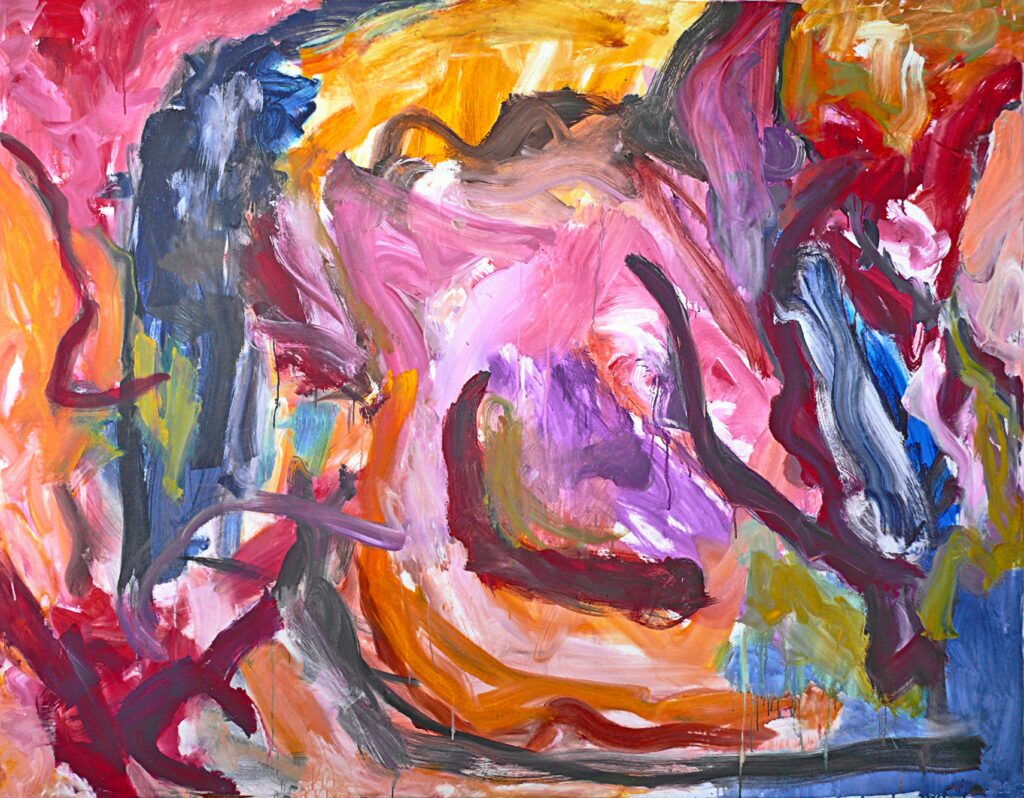
You might choose a colour because it attracts you in that moment. You might make a mark without knowing what it will become. From there, the painting starts to develop.
The important part is that you don’t force it into a specific image.
Instead, you respond to what is already on the page.
Maybe a shape appears and you feel drawn to add another one. Maybe a colour combination surprises you. Maybe you want to cover something up or bring something forward.
The painting becomes a conversation between you and the colours, forms, and structures that emerge.
You are not trying to control every step.
You are listening and responding.
Intuition vs. Traditional Rules
Is intuitive painting the same as painting without rules?
Not exactly.
Traditional art education teaches valuable skills. Learning about perspective, composition, colour theory, light, and shadow can help us understand how images are created.
As an art educator, I value those skills.
But intuitive painting has a different focus.
The question changes.
Instead of asking:
“How do I paint this correctly?”
you begin asking:
- “How does this colour make me want to respond?”
- “What would I like to try next?”
- “What happens if I follow this impulse?”
The goal is not to create something in a specific way.
The goal is to explore, discover, and connect with your own creative expression.
Overcoming Creative Doubt
“I’m not creative. I don’t know how to paint.”
This is something I hear often.
Many people believe they are not creative because they never learned certain techniques. Maybe they received a bad mark in school, someone criticised their artwork, or they compared themselves with people who seemed naturally talented.
Over time, they started believing that creativity belongs to other people.
But creativity is not something you either have or don’t have.
Sometimes it is simply something we stop allowing ourselves to experience.
And this is not only true for beginners.
Even people who paint regularly can struggle with doubt. Having skills does not automatically remove the inner critic.
Intuitive painting creates a space where we can practise relating differently to creativity.
Letting Go of Perfectionism
What if my painting is ugly?
This is probably one of the biggest fears people have.
Many worry about making something ugly. Sometimes they even fear that the painting reveals something about who they are. However, your painting is not you.
It does not define your personality, your abilities, or your worth. Instead, it serves as an expression of something that was present in that moment. Plus, a painting can be meaningful without being beautiful.
It can be interesting because it surprised you. It can be valuable because you allowed yourself to experiment. It can remind you of a feeling, a thought, or a moment of freedom.
The result is not a judgement of you.
It is simply part of your creative journey.
Finding Presence in the Process
For me, intuitive painting is not only about making an image.
It is also about noticing yourself while you create.
You might become aware of your breathing, your body sensations, or the emotions that come up while working with colour. Beyond that, you may notice when your mind wants to take over and control the process, or what happens when you finally allow yourself to trust the next step.
When we work this way, we are moving into a practice of arts-based inquiry. It becomes a space where the painting acts as a mirror for your own thoughts and discoveries, rather than an object intended for public judgement. This is why intuitive painting can become such a profound experience: it connects your body, mind, and soul in a way that feels honest and uniquely yours.
Reconnecting with Childhood Wonder
One of the reasons I love intuitive painting is because it reminds me of how children create.
Children usually don’t begin with the question: “Will this be good?”
They experiment and play, naturally following their curiosity.
They create because creating itself is enjoyable.
Many of us lose this freedom as we grow older. We become focused on doing things correctly, meeting expectations, and producing something worthwhile.
Intuitive painting gives us an opportunity to reconnect with that playful part of ourselves.
Not because we want to become children again.
But because we remember something that was already there:
- You’ll find the joy of exploring.
- Alongside a newfound freedom to experiment.
- And the simple pleasure of creating.
Maybe that is why so many people are surprised by how much they enjoy intuitive painting.
They discover that creativity was not something they lost.
It was something they were always able to return to.
If you are curious about what actually happens during a session, you can read more about what to expect in an intuitive painting workshop to get a better sense of the space we create together.
If you would like to explore this process in a guided space, I invite you to join one of my upcoming intuitive painting workshops. Together, we can practice listening to the paint and rediscovering the joy of creating.
Image credit: Featured image by Fons Heijnsbroek on Unsplash.